

MARIAN MAGUIRE – Tudor Hearth – 19 May-19 June 2026

“Given my work to date, the choice of subject for this exhibition may seem odd. Some background.
In 2018, I was contacted by the National Maritime Museum in Greenwich, UK. My colonial series The Odyssey of Captain Cook and The Labours of Herakles are in their collection but they weren’t emailing about that. They had recently acquired the Armada Portrait of Elizabeth I and were looking for visual storytellers to respond to it. The Armada Portrait is significant, not just as a representation of majesty, but also for its maritime narrative. It celebrates the moment in 1588 when the Spanish Armada failed in its invasion attempt. Through that victory England gained maritime advantage and over the next couple of centuries rose to dominance. Britannia came to rule the waves. From across the waves the British explored the distant South Pacific and eventually gained a foothold on the shores of Aotearoa. Here.
I went to London for a meeting. The curator had seen the Odysseus and Penelope fireplaces online and suggested that I consider that form for my response to Elizabeth. I admitted to her I found the whole thing rather daunting but, coincidentally, I had been thinking of making a Victoria fireplace because of the massive influx of British settlers to New Zealand during her reign. ‘Ah!’ she said (and I paraphrase), ‘One way of looking at it is that Elizabeth and Victoria bookend the main phase of British expansionism.’
Meanwhile I was gathering ideas towards what would become The Enlightenment Project, which delves into the same time period and more besides. While in London, I developed ideas for both projects simultaneously. I visited the Wellcome Collection, Science Museum, British Museum, National Gallery and, of course, the National Portrait Gallery where I could look at other Tudor portraits close up.
When I got home I started the Tudor fireplace but once the two main works of The Enlightenment Project – Sight and Blindness I & II – started to take serious form they absorbed my full focus. Every now and again I returned to the Tudors but could never get a solid swing at it. The opportunity at the National Maritime Museum evaporated – I was simply too slow.
 Finally I completed The Enlightenment Project and the World prints which followed and was thinking about where to head next. Early last year I looked at the now dusty Tudor fireplace, which was cluttering the print studio at Bealey Avenue and thought ‘I’ve got to either finish that thing or abandon it.’ We shifted it to my home studio and at once I got on with it. I had completed the Mary-I-with-burning-martyrs panel years ago plus made inroads into the family tree. I’d done Henry VII’s fingers and the rose on the left hand side. Mary Stuart’s disembodied head and the shape of her body were blocked in but the paintwork was awful. The sword, rose and gun on the top surface were sketched on paper and traced. Henry VIII’s legs with ruined monastery below were taking shape in my head. The carpet on the base was still an idea. I hadn’t even started Elizabeth although I did have a feeling for what I was after.
What interested me was the relationship between the three women – half-sisters, cousins – whose lives were intertwined though they were isolated from each other. Mary I and Elizabeth I, daughters of Henry VIII by different mothers, seldom met as children and only communicated by letter once adult. Mary Stuart, Queen of Scots, was daughter of Henry VIII’s sister and raised in France. She met neither of her cousins but did correspond with Elizabeth in later years. The imperative of succession meant these three women posed a threat to each other. Elizabeth was Protestant, the two Marys were devoutly Catholic.
Henry VIII cleaved England from Rome and died. His young son Edward VI continued Henry’s mission to destroy the monastic infrastructure, then died. Catholic Mary I seized the crown, her teenage kinswoman Lady Jane Grey being sacrificed to clear the way. Mary married Philip of Spain and attempted to rid England of Protestantism by burning its adherents, thus earning the name Bloody Mary. She imprisoned Elizabeth in the Tower. Mary and Philip had no children. She died, Elizabeth became Queen. Philip courted Elizabeth unsuccessfully. Threats to Elizabeth’s rule and life abounded. Cousin Mary became Queen of Scotland and moved from the elegant French court to a chilly castle where she knew almost no one. She married an English nobleman of doubtful character. Complications followed. Mary fled to England and Elizabeth provided refuge in a Northern castle but before long the gates were locked and refuge became prison. Mary Stuart conspired with fellow Catholics and Spain to overthrow Elizabeth, the Protestant heretic. The plot exposed, Elizabeth, with reluctance, signed her cousin’s execution order. The Spanish threat did not disappear however. In 1588 Philip sent an armada, a fleet of huge, state-of-the art, multi-cannoned ships, to invade England.
Perhaps it was the weather, or the manoeuvrability of the smaller English vessels, or the firebombs; one way or another the Armada was vanquished. Elizabeth understood the power of rhetoric. She famously delivered the lines: “I know I have the body of a weak and feeble woman; but I have the heart and stomach of a king, and of a king of England too.” All three women faced extraordinary challenges. Elizabeth was educated. She spoke several languages and, to relax after a vexatious day at court, she translated Cicero from Latin. This is interesting, not just for what it tells us about her intellect, but also because Cicero was a Roman lawyer concerned with how power, law and justice could come together to create better government while mindful of the ruthless manoeuvrings of politics. Elizabeth took her role as monarch seriously and strove to be a ‘good prince’. Surviving as a female sovereign was no easy matter and she relied on the spy network Walsingham set up to protect her. I imagine, despite palace security, she might frequently have slept with a dagger under her pillow and I am quite certain she would have known how to use it. Elizabeth was a fit and physical woman, she rode horses until quite late in life.
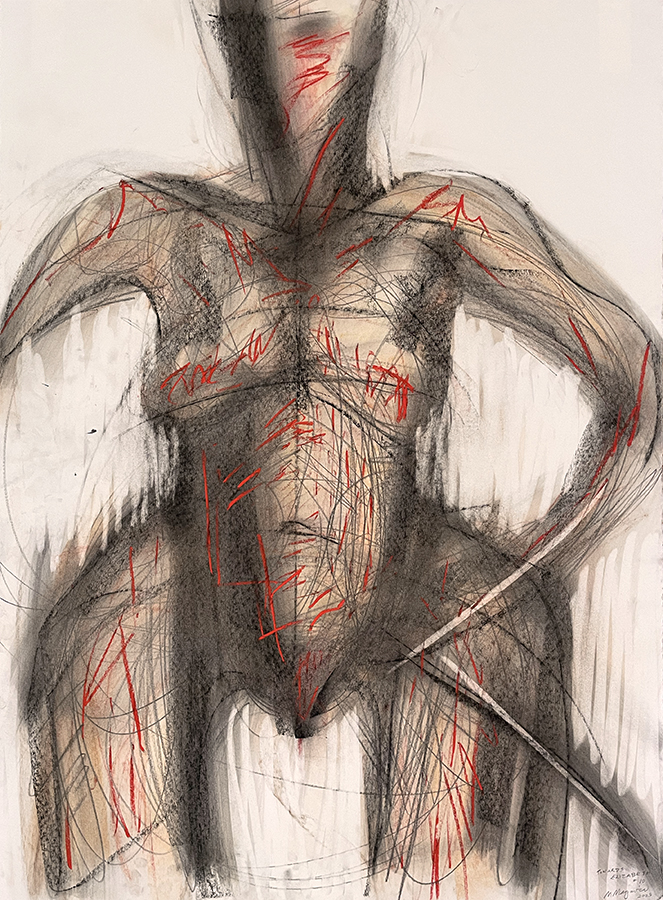
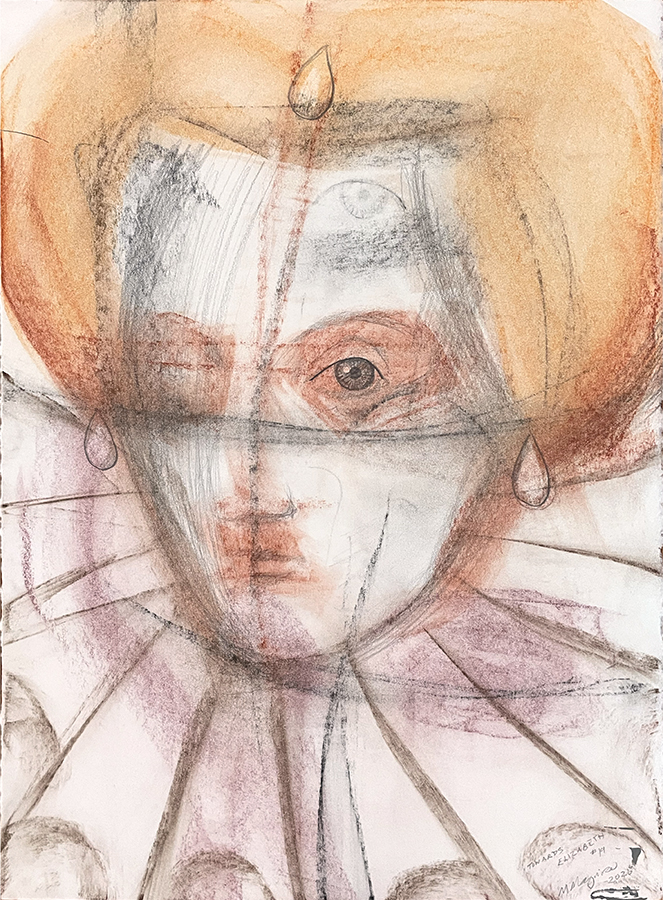
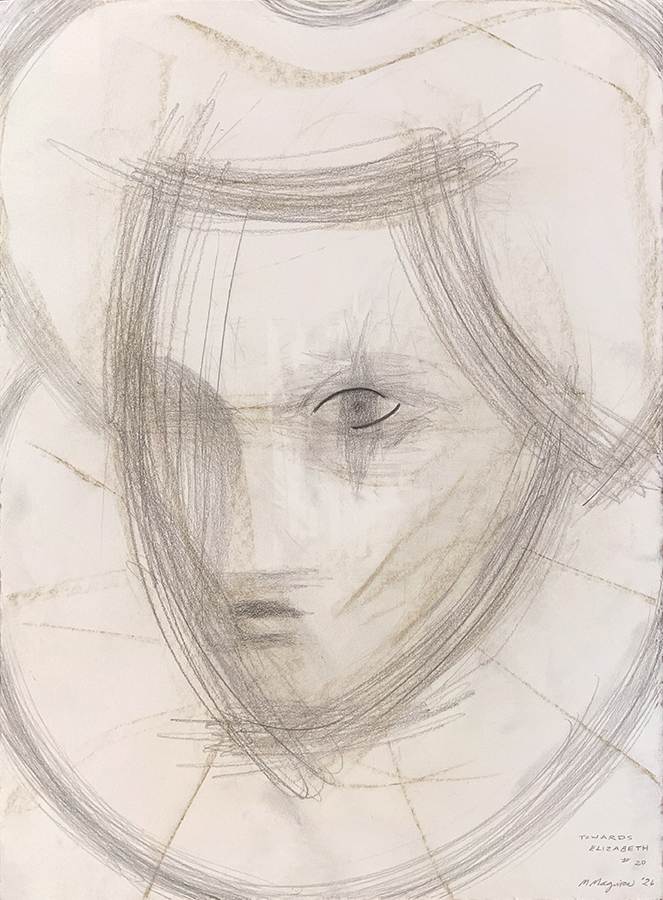
By the time an artist was commissioned to paint the Armada Portrait, Elizabeth presented herself publicly as Gloriana, the Virgin Queen, married to England. All visible skin was coated white. She was beyond touch. To my eye the portrait is a masterpiece. Described as allegorical, it alludes to power, beauty, wealth, strength, victory and naval ambition. The composition balances its intent perfectly. I found I could only respond to this painting by exclusion so thought about the woman’s body beneath. Her back must have been strong to carry the weight of fabric let alone the copious pearls and precious stones. Her deceptively delicate hands are calm but ready to move, the eyes watch, the expression is impenetrable. In 1588 Elizabeth was 55, not much younger than I was when I first started this project. She was staunch until the end. Accounts of her dying days tell that she refused to lie down – instead adamantly standing or sitting motionless for hours on end. She finally died in 1603 and was succeeded by James, the Scottish son of Mary Stuart.
I’ve read a lot of history over the past couple of decades and have been disappointed by the lack of strong women in the texts. But that doesn’t mean strong women have not existed. Glimpses shine through the historical record: sometimes just a name, a sentence, paragraph, occasionally a full chapter. Until recently, the lives and contributions of women have often been dismissed or diminished.
Thank goodness that is changing. Elizabeth is historically pivotal and unerasable. She is a relief.”
– Marian Maguire, May 2026
ARTIST TALK: Sat 6 June, 11am
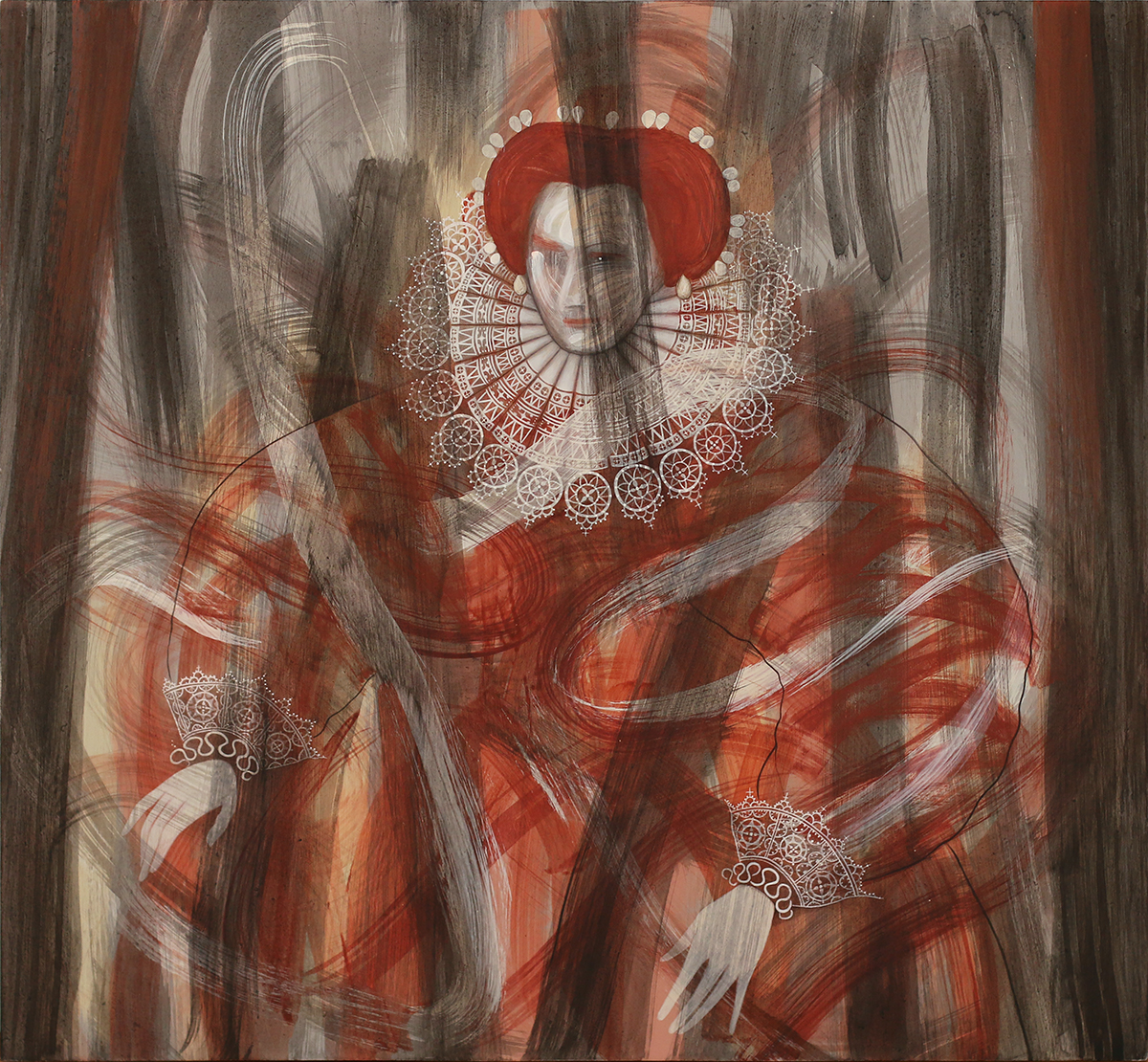
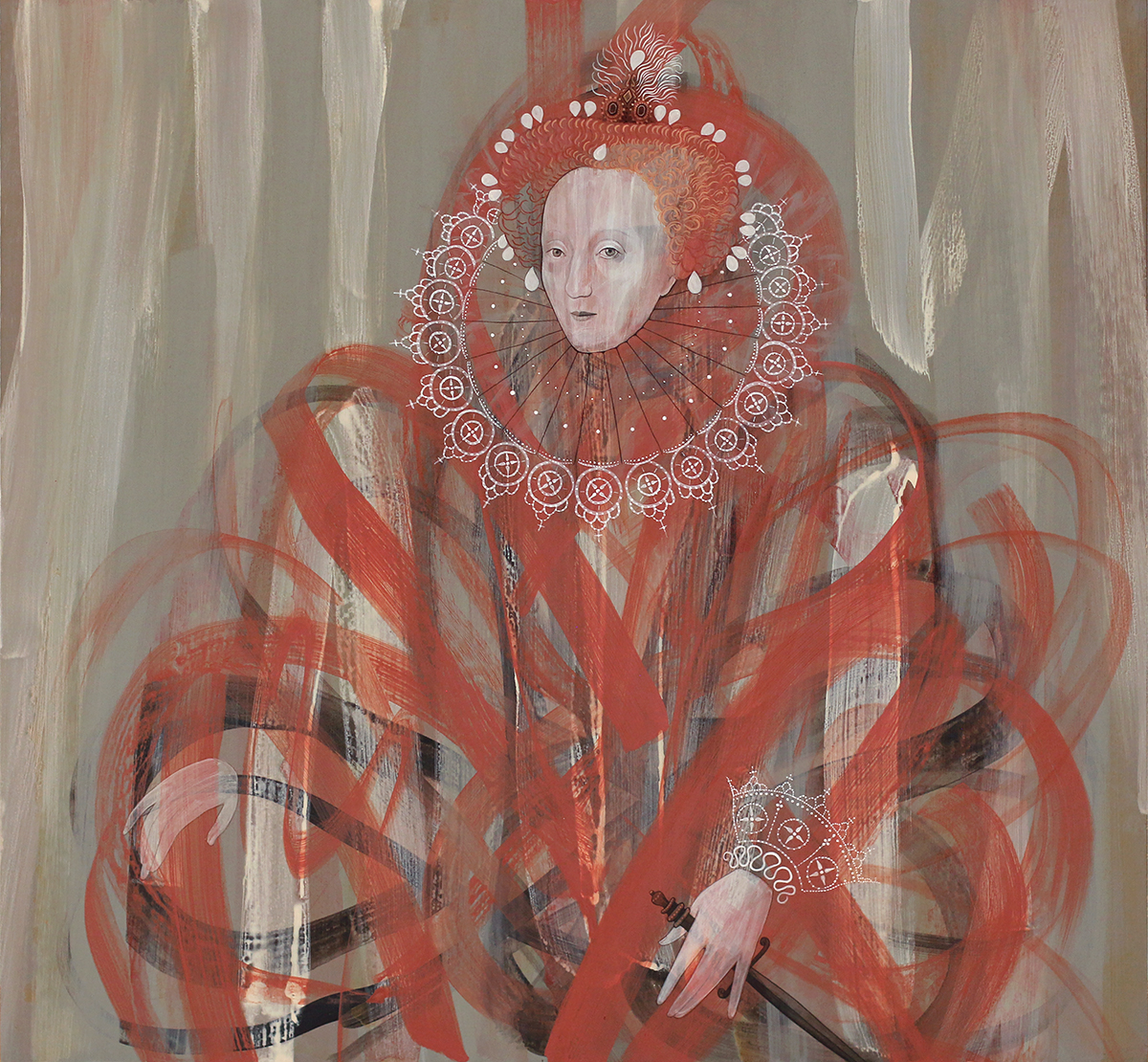
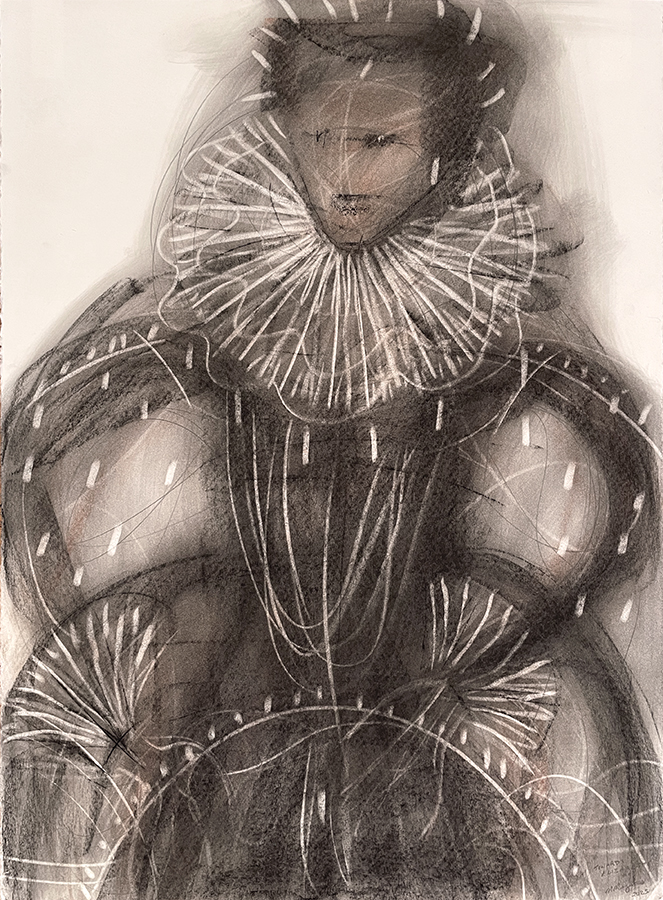
Working drawings (below) towards the Elizabeth I paintings (above)


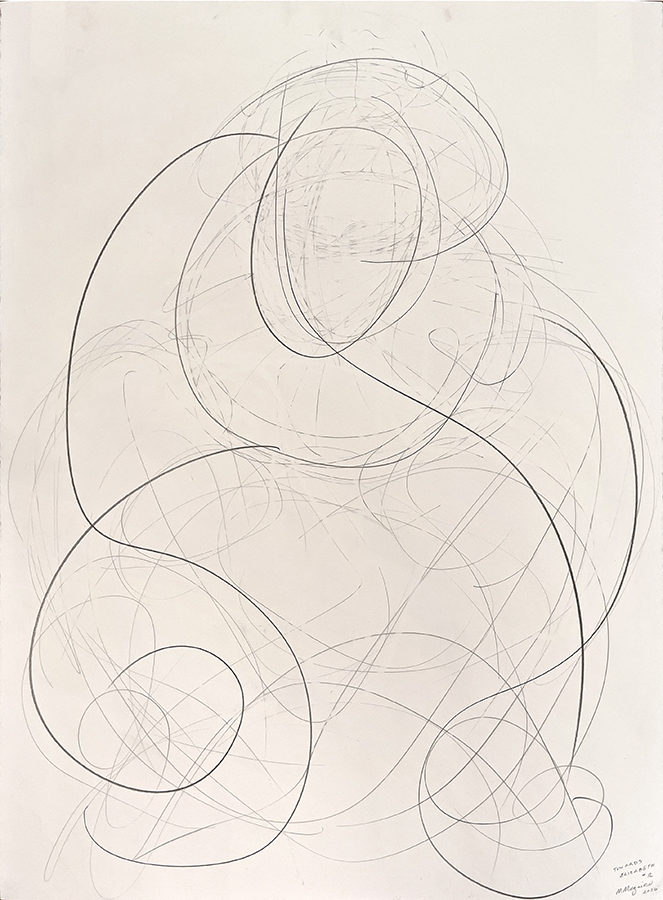
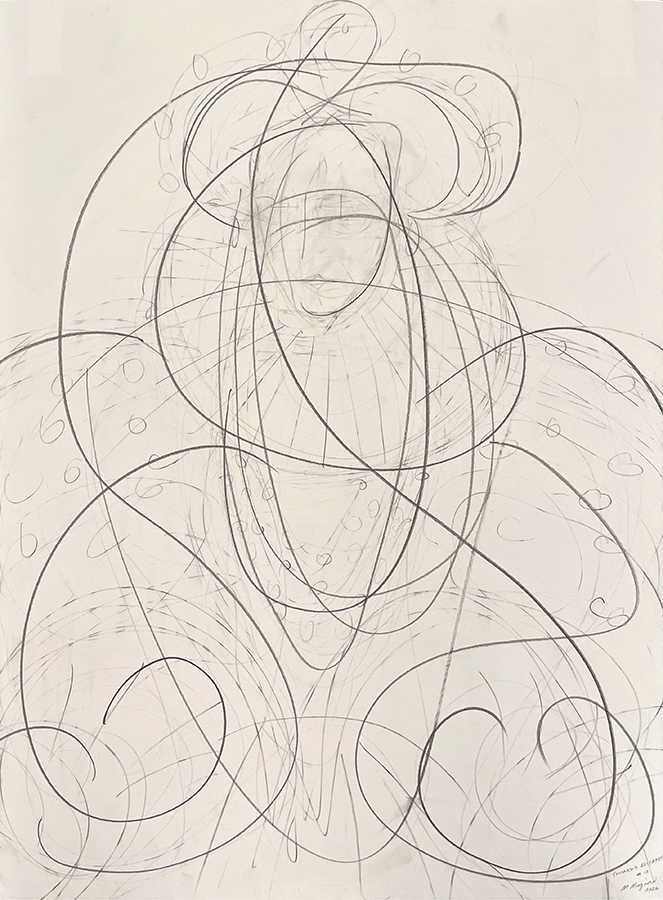

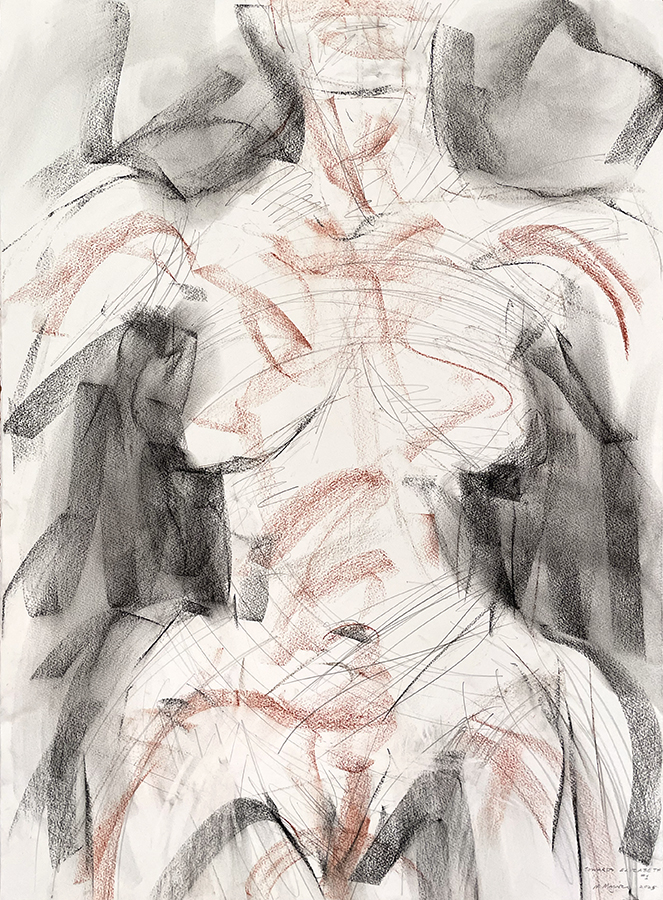

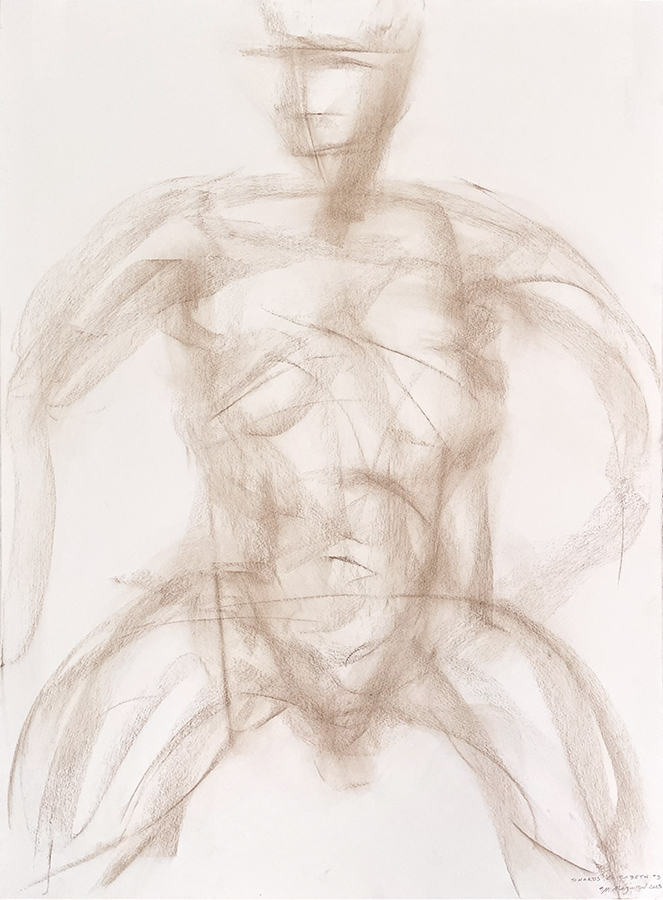
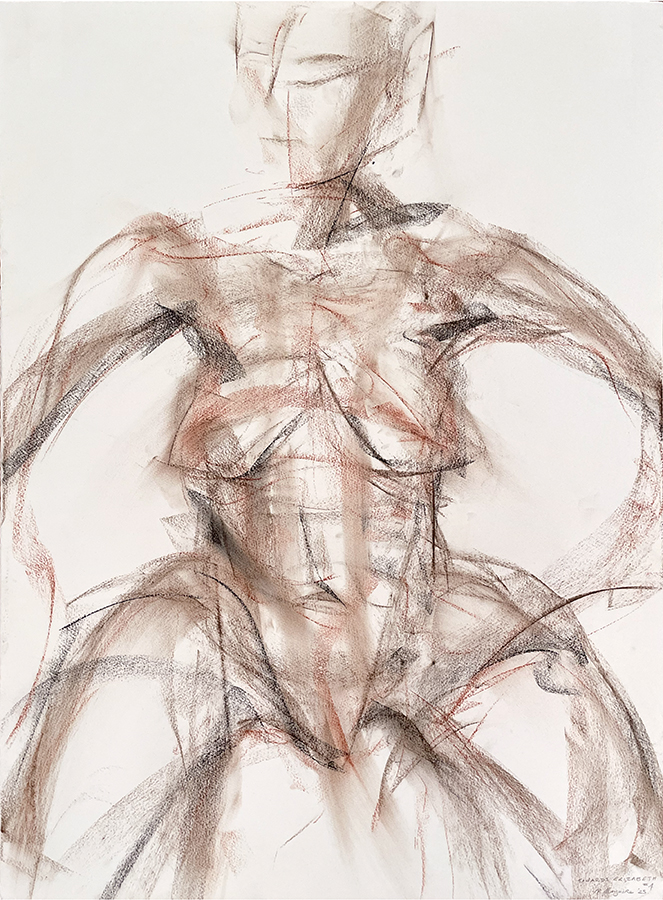

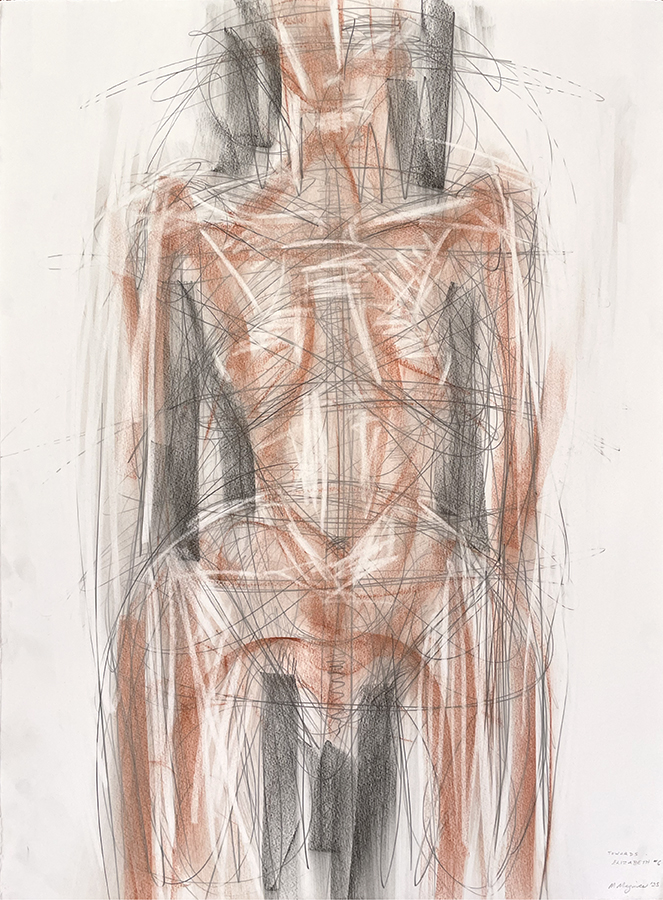

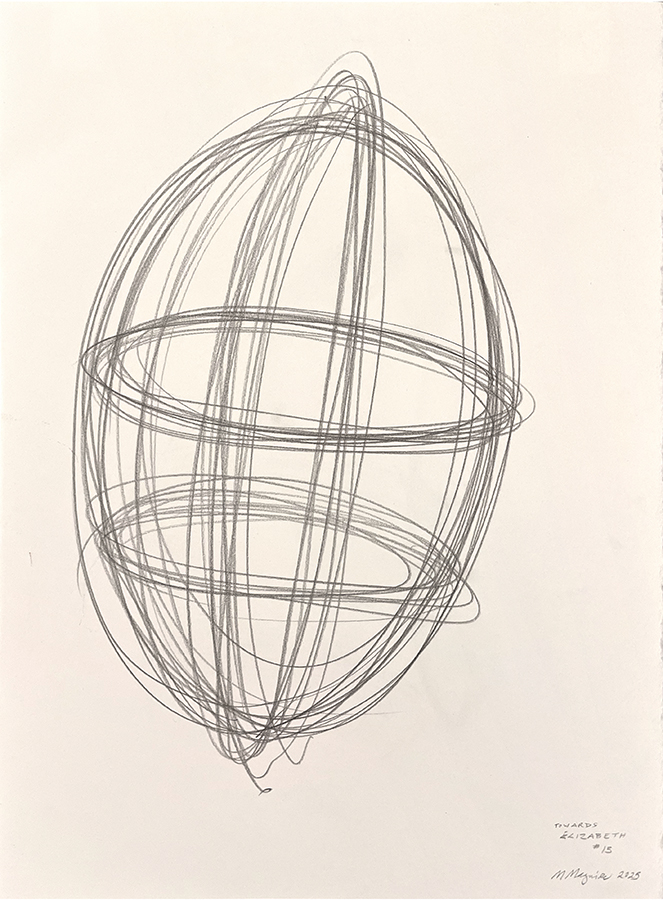
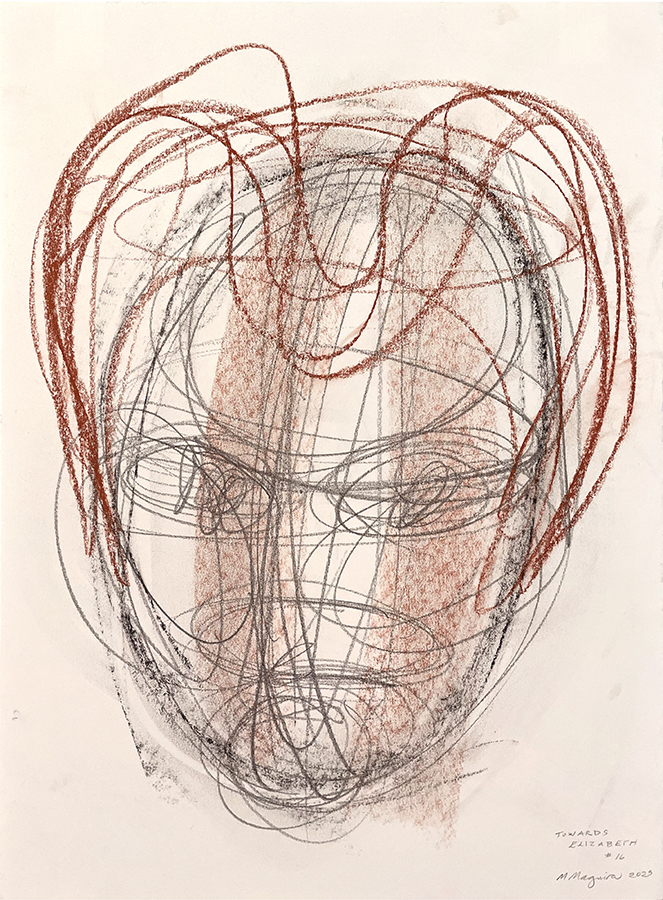




Marian Maguire was born in Ōtautahi Christchurch, 1962, and graduated from the Ilam School of Art, University of Canterbury in 1984. In 1986 she studied at the Tamarind Institute of Lithography, Albuquerque, USA. Her early work was predominantly figurative and gestural. She tightened up to produce her print series that combine Ancient Greek vase painting with New Zealand colonial history. Maguire also makes frequent forays into geometric abstraction and botanical patterning. She has exhibited extensively and her work is held in numerous public and private collections both in New Zealand and overseas.
______________________________________
Accompanying this exhibition are earlier works with connection in either form or content.
Tudor Hearth is the fifth fireplace that Marian has painted. She conceived of fireplace works inseparably from storytelling.
– The first is from about 2009 and is about Achilles. It is installed in her home.
– She painted the second 2012-14 and named it Te Koha. It was renamed Te Toi o Takuahi by descendents of Riwha Tītokowaru Ngati Hāua o Ngaruahine when she gifted it to them in 2018. It resides on marae in South Taranaki.
– The third and fourth are currently on display. They were first shown in 2017.
Odysseus strays into the Realm of Tangaroa and Penelope weaves and waits.

While working on Tudor Hearth, Marian was also working on the The Enlightenment Project and researched for both concurrently.
The two main works in that series are Sight and Blindness I: Reason and Sight and Blindness II: Expansion. They were first exhibited in 2022.


An etching links the Odysseus fireplace to Sight and Blindness II: Expansion.
Map of New Ithaca, from 2006 was drawn soon after Marian completed The Odyssey of Captain Cook print series when her interest in voyaging began.
