

Echoes of the (un)familiar – group exhibition 10-27 Nov 2026
Echoes of the (un)familiar
10-27 Nov 2026
Megan Brady, Bena Jackson, Carlos Knight, Malia McLellan, Lewis Robertson


This exhibition brings together artists who, through distinct practices, engage in the reconstruction of subject, self, medium, or meaning. While each artist tells their own story, an underlying thread maps the terrain between what is seen and what is felt, capturing the delicate friction where image meets experience. Boundaries of belonging blur into something both intimate and expansive, where subjects and materials act as vessels of memory, often carrying emotional residue.
FLOORTALK: Sat 21 Nov, 11am

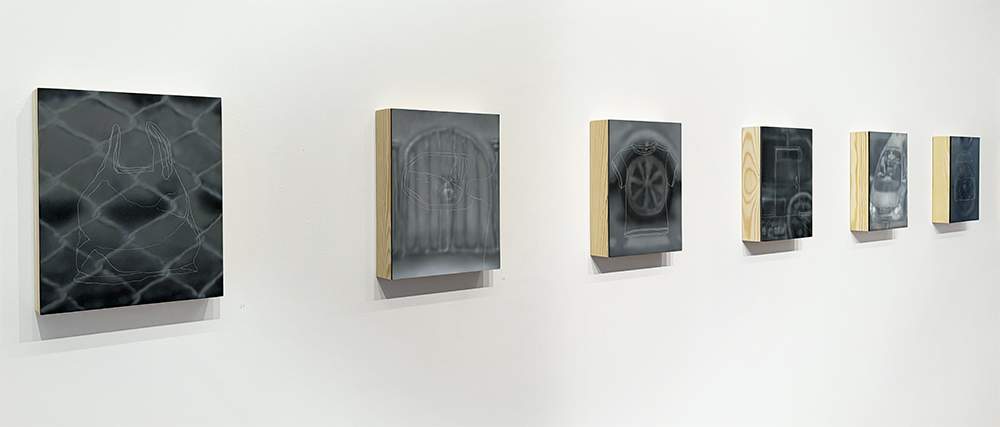
Lewis Robertson describes his painting process as gathering and reconfiguring imagery drawn from daily habits and consumed media. Rather than starting with an overarching theme, his compositions emerge through free association and visual instinct. By retaining the immediacy and ambiguity of their source material, the paintings allow contradictory, incidental relationships to remain open-ended. Although these fragments initially share no connection other than resting in a single person’s memory, their transmutation into art suggests an internal symbology. This invites viewers to look for more than coincidence, probing for active authorship and intent that may or may not be there at all. Ultimately, each painting functions as a multi-stable image: as one iteration and its potential meaning comes into focus, another blurs away. This creates a fork in the interpretive road. It challenges viewers to search for meaning in the constituent images, or to play an association game between them, looking for a common thread between the two subjects.
Ōtautahi based painter Lewis Robertson, completed an MFA with Distinction (2024) and a BFA with First Class Honours in Painting (2022) at Ilam School of Fine Arts, University of Canterbury. He was a recipient of the Harry van der Lecq Scholarship (2022), the Ethel Rose Overton Scholarship (2022), and a SELECT Award (2023).


Megan Brady thoughtfully describes this ongoing body of work titled Windows, as an enquiry into acts of looking and layering. This iteration is a series that references the growth rings of trees and ideas of whakapapa as she holds her new baby and looks out upon their garden as it grows and changes.
Brady has refined a specific drawn-thread technique, passed down by her Nan – carefully removing warp and weft threads from woven linen, to reveal patterns held within the fabric. An act of drawing through subtraction, where what’s removed becomes light and aperture. These subtle unweavings create thresholds that offer light and shadow conversations, as well as pose questions around discovery and exposure. The works reflect on tightly bound systems – colonial structures, naming conventions and whakapapa and gently loosens them. While threads are removed from the commercially woven European Flax Linen, Brady introduces muka, a fibre extracted from harakeke, with personal whānau significance as an additional fibre, to bind and support the works.
Botanically, harakeke is not flax. It belongs to the Phormium genus, part of the day-lily family, while linen comes from Linum usitatissimum, a member of the flax family. Here she is interested in the tension between indigenous and colonial naming, plant and fibre, material and metaphor. Distinctions that go beyond the botanical as they shape national identity, land use, and cultural knowledge and perception.
Brady explores this practice of unweaving imposed European constructs and conceptually reweaving the material with whakaaro connected to Te Ao Māori, te taiao o Aotearoa and personal and cultural reclamation. The process of unweaving is not about erasure, instead it is a slow, deliberate act of reveal and return.
Ōtautahi based Megan Brady (Kāi Tahu – Ngāi Tūāhuriri, Pākehā) is the recent 2026 recipient of the Olivia Spencer Bower Award and 2025 Styx Pūharakekenui Catchment Artist in Residence. She completed her bachelor of Fine Arts with First Class Honours in 2017, Dunedin School of Art.


Bena Jackson excavates the material traces of public intervention in urban spaces. Transforming ordinary civic elements into evocative constructions, she reshapes items usually lost or overlooked. Jackson’s mosaic bollards juxtapose two contrasting elements: precious tiles once used in public spaces and the heavy-duty bollards engineered to separate cars, people, and spaces today. Bringing these objects into a gallery creates an inherent friction. Void of vehicles to stop or traffic to direct, the rugged street barriers are transformed into vulnerable sculptures. Stripped of their utility, they invite close inspection and demand our care. Their surfaces display Jackson’s intuitive mark-making, mirroring the consistent cycle of council upkeep followed by pedestrian interaction. Through layers of applied and peeled paint, of etching and spraying, the work exposes its material endurance. It prompts reflection on maintenance and care, and the slow, inevitable wear of weather and civic life – more humanly shown in the playfully adhered berry chewing gum. Shaped by growing up in Ōtautahi through the 2010 and 2011 earthquakes, Jackson’s practice often draws on the landscape of our post-quake city. Juxtaposing her weighty bollards – on the opposing wall drape delicate chains fashioned from foraged street detritus. While each singular fragment carries its own memory of a former life, interwoven together they transform into something entirely new. Aptly titled Rain Chain, the undulating amalgamation mimics chain barriers that are typically used to manage pedestrian flow and restrict access. Together, these works echo a sense of enduring collectivity that can persist despite fragmentation.
Te Whanganui-a-Tara-based Bena Jackson holds a Master of Fine Arts from Toi Rauwhārangi, Massey University, Wellington, Te Whanganui-a-Tara. During this time she was awarded the 2023 Iris Fisher Scholarship and the 2022 Collin Post Memorial Scholarship. Exhibiting works courtesy of PEG gallery.


Through long and double exposures, Malia McLellan’s black-and-white photographs capture the movement of the human form, along with familiar bodies of water to explore her Niuean heritage. Although being taught a few Niuean words by her grandfather when she was much younger, McLellan reflects that some traditions and much of the language were never passed down. Her evocative compositional choices and titles seek to capture the struggle of connection and act as a reclamation. Rather than offering translation, the artist emphasises the autonomy of the Niuean language, allowing it to hold its own presence. In each work, shadows dance, ocean tides ripple, and the human form weaves a connection across the layered depths. In Ko e Hoko and Uneune silhouettes of moving hands are overlaid across a northwest coastal horizon facing Niue. McLellan explores not only physical distance but also the physicality of movement and the intimacy of hands. In doing so, she highlights the tie to Niuean cultural and traditional dances, which heavily feature expressive hand, arm, and body gestures. Revealing her palm in Mavēvaga, the image whispers of uncharted lineages and ancestral history; below, light on the water mirrors the shifting, fluid nature of language. Taken on 120mm film, these images are developed by hand using water from Tāmaki Makaurau, connecting her to the place where she was born and raised. This process acts as an anchor, bridging the physical distance between her life here in Ōtautahi and her home in Te Ika-a-Māui.
Malia Mclellan is based in Ōtautahi and recently completed her Bachelor of Fine Arts with First Class Honours in Photography (2024) at Ilam School of Fine Arts, University of Canterbury.

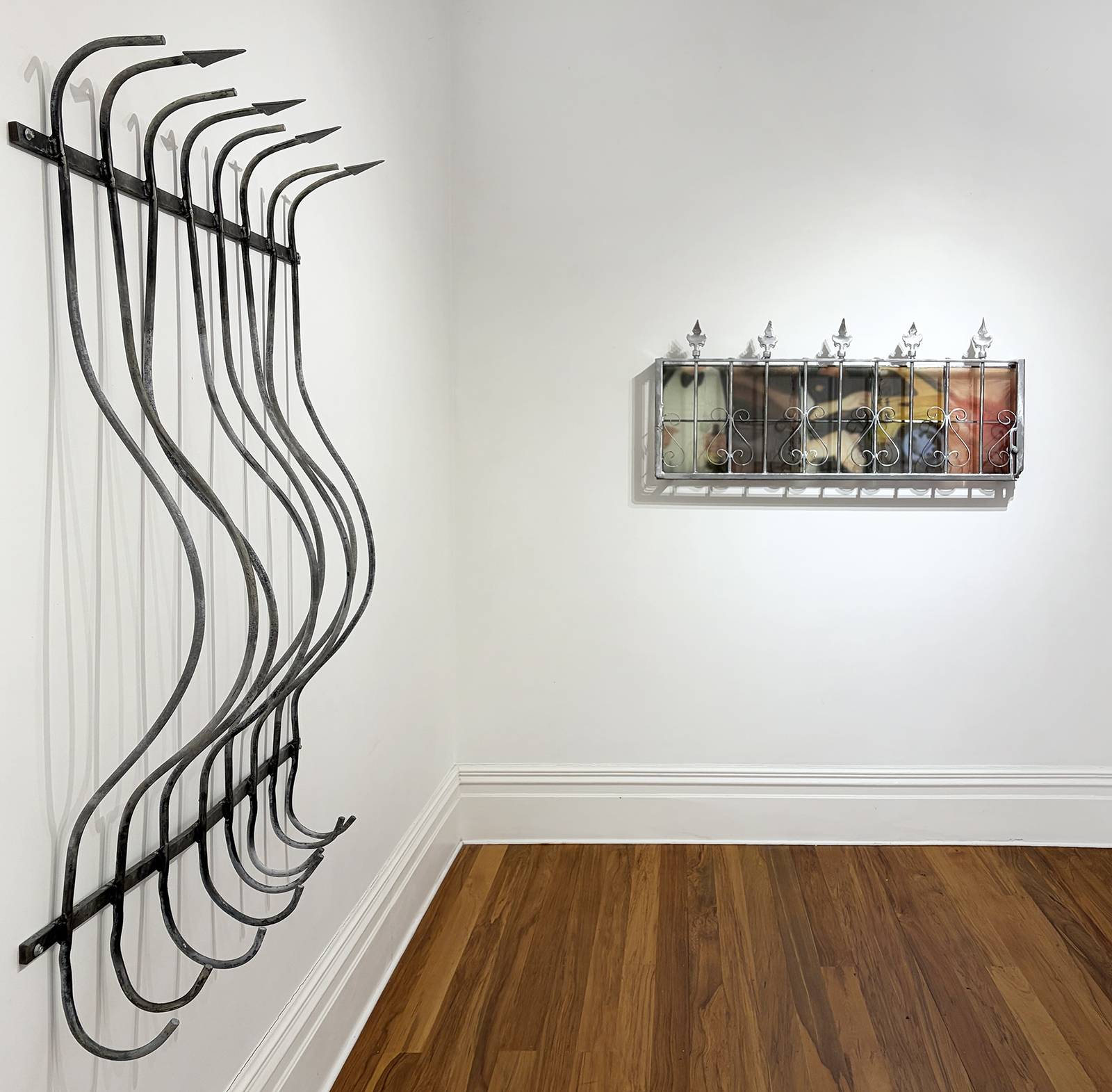
Carlos Knight’s practice visually dissects the idiosyncratic moments of shared urban, public and domestic environments. Through a willingness to slow down and observe, he allows everyday spaces and people to dictate their own relationships. His works blur the boundaries between the functional and the sculptural, the familiar and the unfamiliar. A doorway split into conversation sits alongside a galvanized steel window-grate layered with stained glass; together, these reworked barriers recreate and subvert the act of peering across thresholds. Laden with footprints and the material index of place, these visual gateways capture human interaction, wear, and reuse. Knight collects retired objects out of curiosity when form and function misalign, reassembling them into resonant new structures. Within an art gallery, loosened from previous context, these transformed objects operate as ideas. They echo their previous lives while stimulating us to probe how we see, feel and relate to our surroundings.
Ōtautahi based Carlos Knight completed his Bachelor of Fine Arts with First-Class Honours (2025) at Toi Rauwharangi, Massey University, Wellington, Te Whanganui-a-Tara. During this time, he received the Collin Post Memorial Scholarship in Sculpture.